

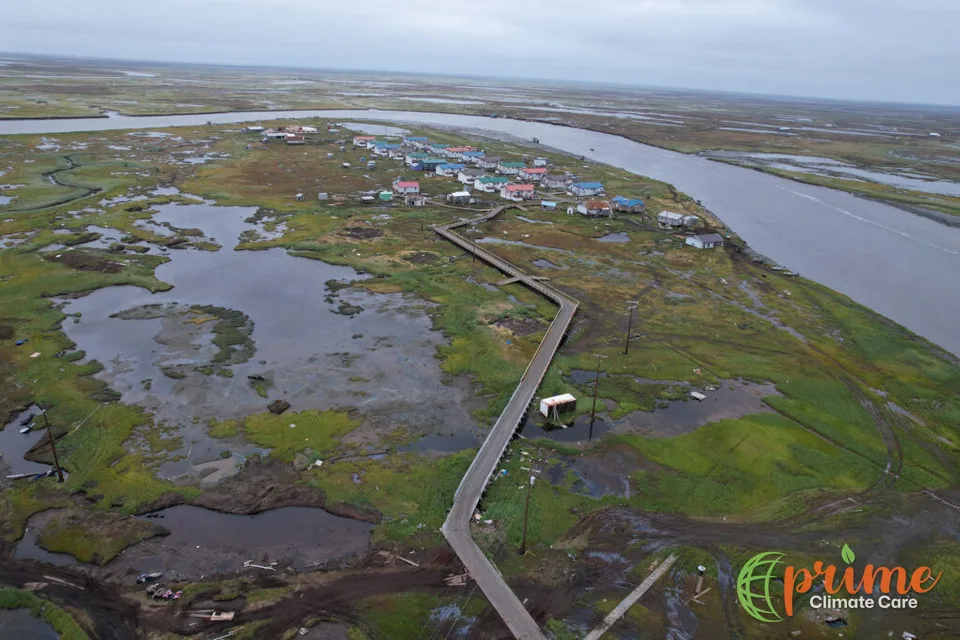
A year after Typhoon Halong, most residents of Alaska's Kwigillingok village remain displaced
Rebuilding and relocation of the Yup'ik village of Kwigillingok have stalled since a record storm surge struck in October 2025, leaving most residents far from home.
Summarised by Prime’s AI news desk from Inside Climate News (opens in a new tab), and published automatically without prior human review. Please report any errors through our contact page.
More than a year after the remnants of Typhoon Halong struck south-western Alaska on 12 October 2025, most residents of the Yup'ik village of Kwigillingok still cannot go home, Inside Climate News reported on 31 October 2026. Efforts both to rebuild the village and to move it to safer ground have stalled, leaving families scattered across the region as a second winter approaches.
A village swept by the sea
Kwigillingok sits about a quarter of a mile from the Bering Sea. According to the report, south-westerly winds and a full-moon high tide pushed a storm surge (a rise in sea level driven by a storm) more than 6.3 feet above the normal highest tide line, over twice the previous record. The water lifted 46 of the village's 99 houses off their foundations, tore up boardwalks and power lines, and washed away boats, vehicles and freezers of stored food. Three people died.
The storm affected more than 40 communities in the Yukon-Kuskokwim Delta. The evacuation of about 1,500 people from Kwigillingok, Kipnuk and Nightmute was described as the largest domestic rescue operation in Alaska's history.
Of the 361 people who lived in Kwigillingok before the storm, about 30 have returned, even though damaged housing, plumbing and the water pipeline leave the village largely unlivable. Most others remain in Bethel, Anchorage and nearby communities under a "no-go-home" order. Lucy Martin, the village's tribal resilience coordinator, is still in Bethel, about 70 miles away. "I have no house," she said.
Slow repairs and a funding gap
The report says the recovery has been delayed by shutdowns of the US Department of Homeland Security, which includes the Federal Emergency Management Agency (FEMA). No construction crews worked in the village from early September to mid-October 2026; a state transport department spokesperson said crews were waiting for FEMA funding.
The State of Alaska has committed 75 million US dollars. FEMA has approved 62.9 million dollars in individual and housing assistance for more than 2,500 households, a further 40.2 million dollars in other aid, and almost 9 million dollars for infrastructure repairs. The state's request for additional permanent housing funding was denied after eight months, and it plans to appeal. Bryan Fisher, director of the Alaska Division of Homeland Security and Emergency Management, estimates total recovery costs will exceed 400 million dollars.
Resident Darell John criticised the quality of repairs and said the community was not consulted. The transport department said it worked directly with tribal leaders to prioritise homes.
Moving to higher ground
In 2026, Kwigillingok and Kipnuk voted to relocate. Residents say thawing permafrost (ground that once stayed frozen year-round), sinking land and erosion make the current site unsafe. Yet Fisher said neither federal nor state disaster programmes are designed to move communities. "There is no federal program that really addresses relocation or managed retreat," he said.
Andrew Rumbach of the Urban Institute said a FEMA option known as an Alternate Project can help rebuild specific facilities elsewhere, but covers only limited parts of a move. Martin is collecting drone and mapping data to support grant applications for resettlement.
Why it matters for Tanzania
The story shows how one extreme storm can force a whole coastal community from its land, and how existing disaster funding is often built for repairing damage in place rather than helping people move to safer locations. Tanzania's coastal and low-lying communities also face risks from rising seas, storms and flooding, and questions about where and how to rebuild after disasters are relevant at home.
The gap between recovery needs and available money in Alaska also echoes debates in international climate talks, where developing countries including Tanzania have pressed for reliable support to cope with climate-related loss and damage.
Source: Inside Climate News
Topicsstorm surge · climate displacement · disaster recovery · coastal communities · alaska

Comments
No comments yet. Start the conversation.
Leave a comment
Comments are read by our team before they appear. Your email address is never published.